 Pro
ProAutomaton
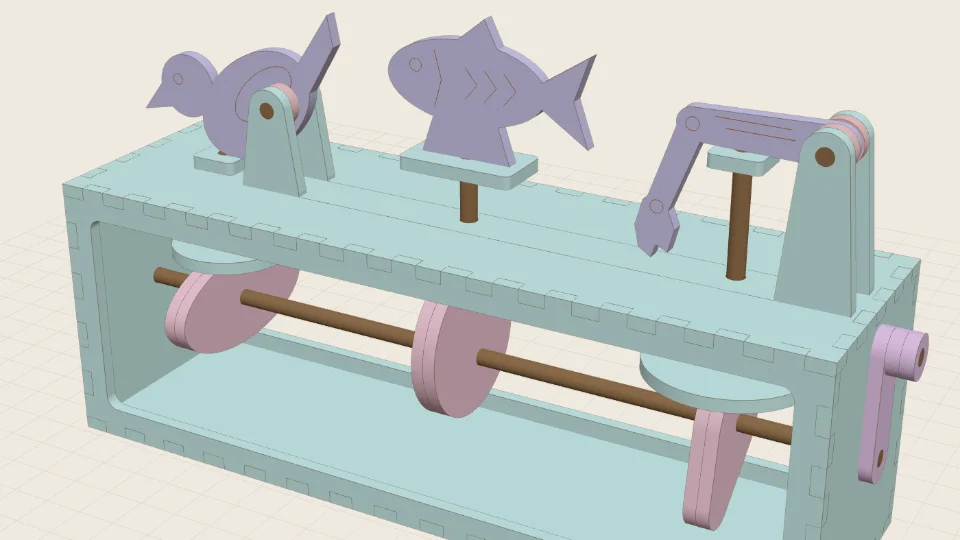
Turn the crank and the figures on the box come alive.
Ask for a ratio and get the gears, in a frame with a crank and a dial.
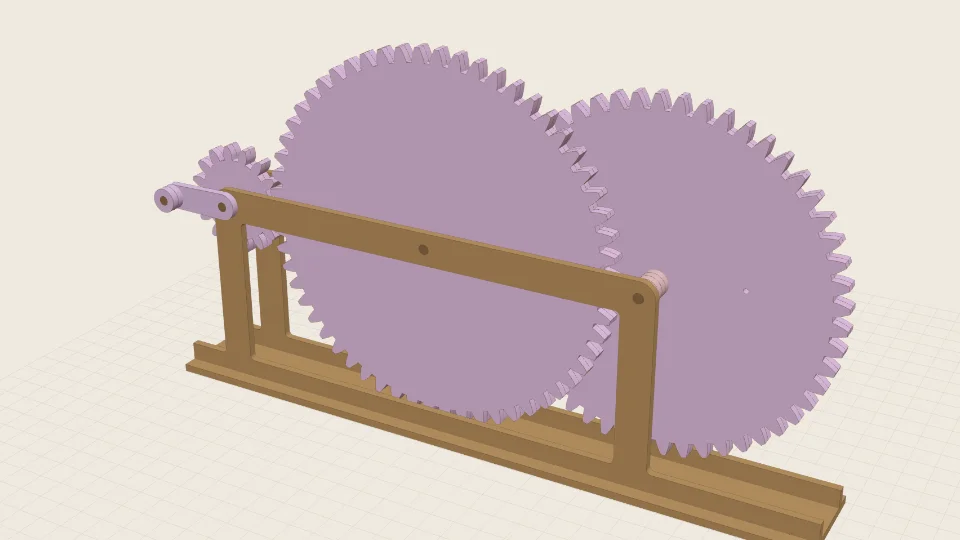
In short: Involute spur gears that turn the ratio you ask for: the solver picks the tooth counts for up to three stages. Laminated gears on rod axles in a frame, a crank on the input and a pointer over a dial on the output. Checked for clean meshing and for collisions while it turns.
Enter the ratio you want and the generator works out a gear train that turns it: a solver picks the tooth counts for up to three stages, so a 1:20 reduction becomes something you can actually cut, rather than one tiny pinion and one enormous gear.
The gears have true involute teeth. Each is laminated from several sheets and pressed onto a rod axle that turns in a frame. A crank drives the input, and a pointer on the output moves over an engraved dial, so you can see the ratio at work.
Gears are unforgiving of small mistakes, so the design is checked for clean meshing (no interference, enough teeth in contact) and for overlaps while the crank turns a full circle. It makes a good desk demonstration of gearing and a base for your own mechanisms; the automaton is built on it.
You need: plywood, steel rod for the axles, and glue. Cut the fit test to get the rod holes right.
All of these can be changed in the app, and the 3D preview updates as you type. The name under each setting
is its key in a share link, e.g. https://laserpuzzle.app/app/#/gears?ratio=…; a link only
needs the settings that differ from the defaults.
| Setting | Default | What it does |
|---|---|---|
Ratioratio | 12 | Crank turns per turn of the output. Above 1 slows down (more force), below 1 speeds up. From 0.03 to 200. |
Ratio tolerancetolerance | 0.5% | How far the real ratio may be from the one asked for. Fewer stages and smaller gears are chosen within it. From 0 to 20 %. |
Stages at mostmax_stages | 3 | Pairs of meshing gears. Each stage turns up to 6:1. From 1 to 3. |
Output turnsdirection | either | Direction of the output relative to the crank. Every stage reverses it. Options: either, same, opposite. |
Tooth counts (optional)train | — | Set the train by hand instead, as driver:driven per stage from the crank, e.g. '12:36 15:45'. |
Fewest teethmin_teeth | 12 | Smallest gear the solver may use. Pairs that wouldn't mesh cleanly are skipped anyway. From 6 to 100. |
Most teethmax_teeth | 60 | From 8 to 200. |
Modulemodule | 2.5 mm | Tooth size: pitch diameter = module x teeth. 2.5-4 mm suits 3 mm plywood. From 1 to 10 mm. |
Pressure anglepressure_angle | 20 ° | 25 deg gives stronger teeth and allows smaller pinions; 20 deg runs a little smoother. Options: 20, 25. |
Backlashbacklash | 0.15 mm | Each tooth is this much thinner at the pitch circle, so the gears don't bind. From 0 to 1 mm. |
Gear thicknesslayers | 2 sheets | Sheets glued together per gear. Thicker gears mesh more reliably. From 1 to 4 sheets. |
| Setting | Default | What it does |
|---|---|---|
Layoutlayout | straight | Straight keeps the axles level, for a low frame; zigzag folds them up and down, for a shorter one. Options: straight, zigzag. |
Crank on the inputcrank | on | Off: the input axle sticks out at the front instead, to drive it from something else. |
Pointer and dial on the outputpointer | on | Off: the output axle sticks out at the back instead. |
| Setting | Default | What it does |
|---|---|---|
Pin diameterpin_diameter | 4 mm | Measured diameter of the dowel or rod used for the axles and the crank handle. From 2 to 8 mm. |
Press-fit hole offsetpress_fit | -0.1 mm | Hole = pin + this, where a pin is fixed (and in the wheels). Find it with the fit-test hole strip. From -1 to 1 mm. |
Axle hole offsetaxle_fit | 0.2 mm | Hole = pin + this, where an axle or shaft turns, or a pin has to come out by hand. From -0.2 to 1 mm. |
Plus the material and machine settings every generator has: material thickness, kerf, slot clearance, sheet width, sheet height, part spacing, engrave part labels, cut line colour, engrave line colour.
ProTurn the crank and the figures on the box come alive.
 Pro
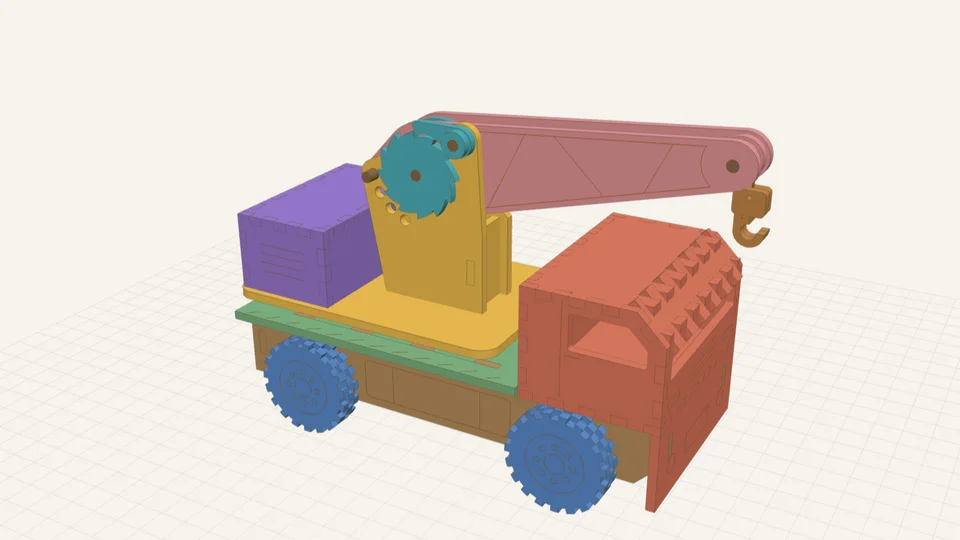
ProA crane that really lifts: turn the crank to wind the hook up, a ratchet holds it.
 Pro
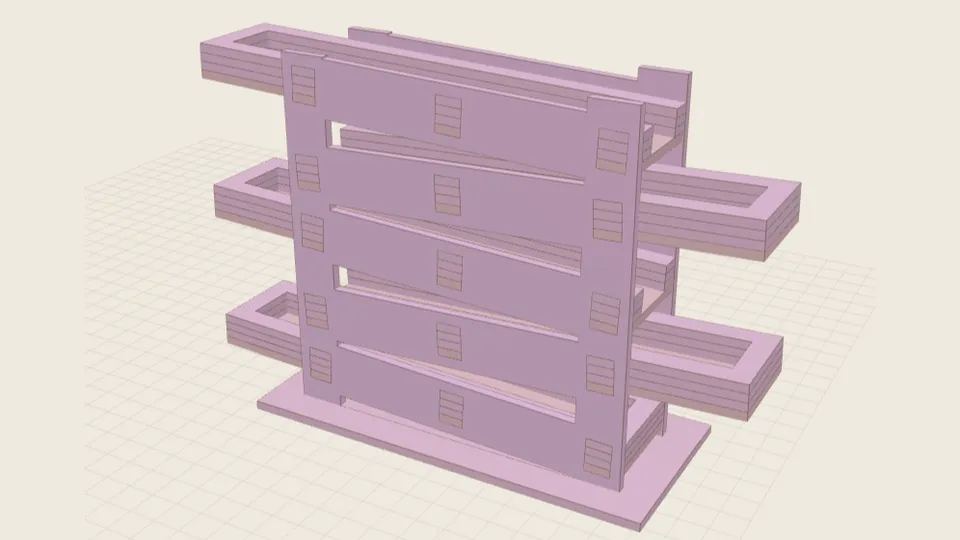
ProA tower of tilted trays a ball rolls down, simulated so it runs when you cut it.